1992 Exposition De Jeunes Peintres Coreens A Paris
- Dates
- Feb 3, 1992 – Feb 8, 1992
- Location
- Escalier Gallery, Paris, France
- Type
- group
Exhibition Background
‘1992 Exposition De Jeunes Peintres Coreens A Paris’ was held at Escalier Gallery in Paris, France, from February 3 to February 8, 1992. Bringing together young Korean artists, the exhibition was framed through the idea of psychological dynamism, highlighting works in which impressions and memories are poured onto the picture plane with force and immediacy. In this context, dynamism extended beyond its philosophical sense as the force that generates natural phenomena in the universe. The mind itself became the source of movement, and painting referred to a way of making in which the artist reflects her own act through it. Rather than simply describing external subjects, the exhibition focused on pictorially realizing a more flexible and more deeply layered inner world.
Guiyoung Lee exhibited Modern Space (1991), a work that brings into a single pictorial field the structural order of urban space and the idea of a return to nature, two elements she had been exploring throughout her early work. The work’s crossing of cold architectural order and organic vitality makes clear the pictorial energy and psychological orientation already visible in her practice in the early 1990s.
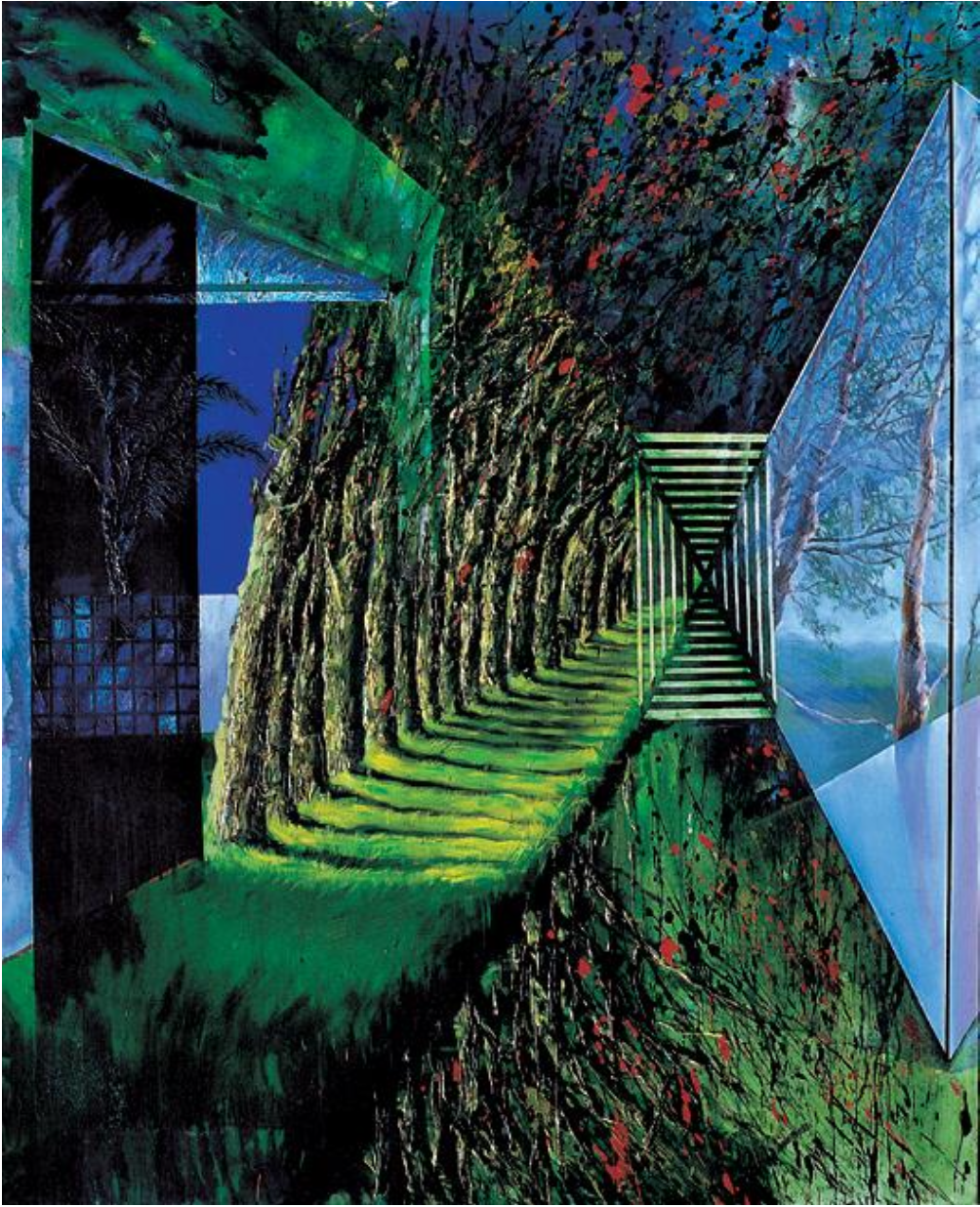
Guiyoung Lee, Modern Space, 1991, Acrylic on canvas, 162 × 130.3cm
Artwork Description
The painting is built around the idea of a return to nature. The urban spaces that had appeared in Guiyoung Lee’s earlier work fall away here, while transparent glass architecture emerges as a structural emblem of modern painting. Even this architecture is overtaken by foliage and vines, so that the whole surface takes on an almost entirely green atmosphere. Guiyoung Lee treats the verdure with forceful action painting, introducing dynamism into the receding perspective and reinforcing the work’s meaning.
Trees are the painting’s central motif. The trees reflected in the glass surfaces of modern space and the trees of the forest may seem opposed, yet the composition draws them into a single flow, as though all were being pulled back into nature. The gestural traces left in the trees convey the vitality of nature itself. Through nature, which endures the cold of winter and teaches the persistence of life through all four seasons, the painting imagines a space of inward refuge for modern life, offering steady comfort and strength in moments of fatigue and burden.
At the same time, Guiyoung Lee was regarded as moving toward a dynamism that drives the picture into a more urgent composition through diagonal structure, rigorous geometric lines, tachiste brushwork, and the placement of hyperreal and non-objective trees within a single pictorial field.