Passage_09
- Dates
- Jul 23, 2009 – Aug 3, 2009
- Location
- Universal Cube, Halle 14, Leipziger Baumwollspinnerei, Leipzig, Germany
- Type
- group
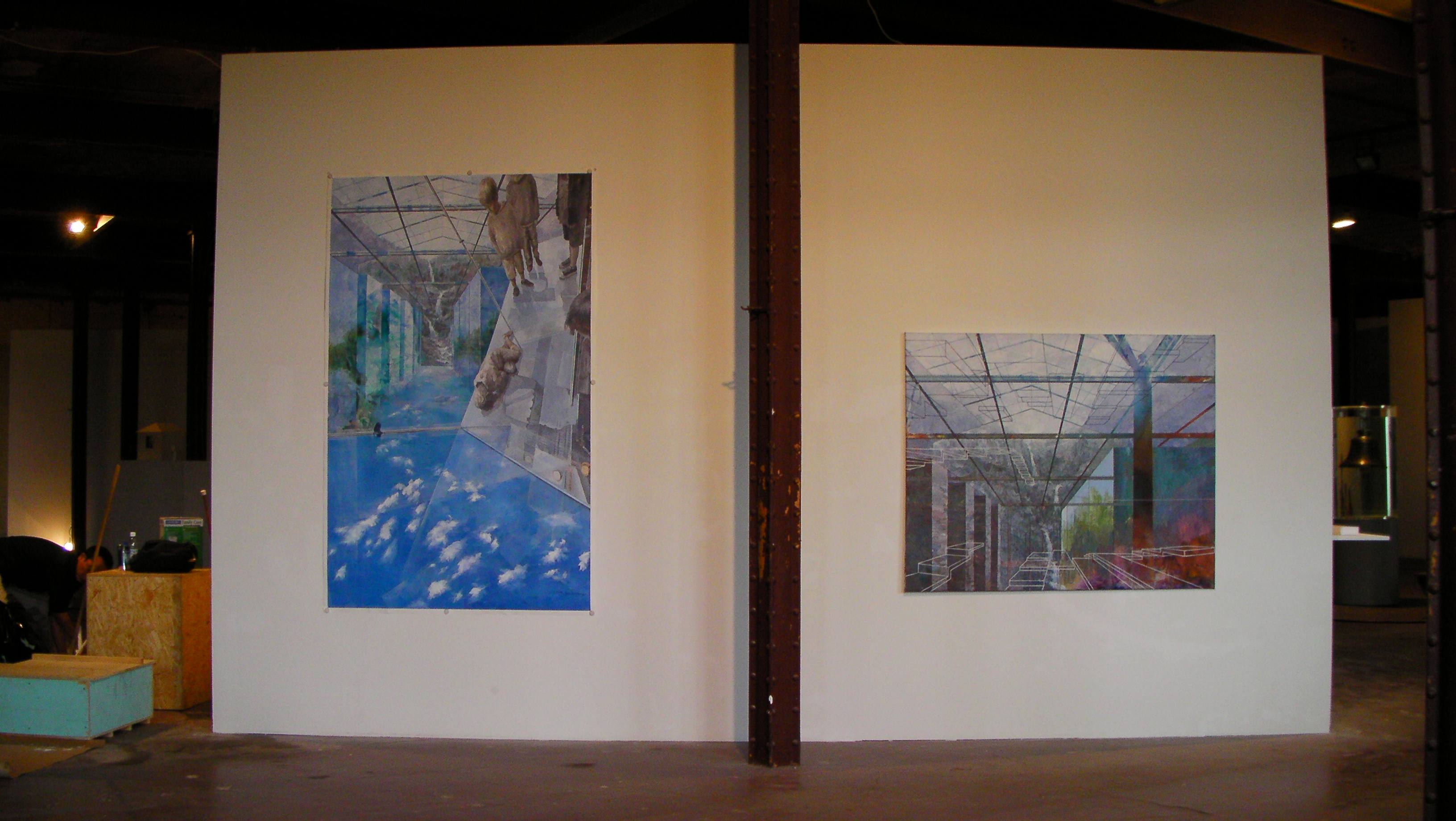
Exhibition Background
Passage_09 was a Korea-Germany exchange exhibition held from July 23 to August 3, 2009, at Universal Cube/Halle 14 in Leipzig, Germany. At the time, Universal Cube functioned as an experimental exhibition platform run by the installation and spatial practice class at HGB Leipzig, creating a setting where artists from different regions and cultural contexts could bring their contemporary visual languages into dialogue.
In this exhibition, Guiyoung Lee presented paintings that brought the visual sensibility of Korean natural landscape into dialogue with contemporary architectural space. Rather than simply depicting nature, she explored a contemporary spatial awareness through a sense of landscape newly perceived and expanded within architectural and urban environments.
Lee’s paintings aligned closely with the exhibition theme by suggesting that passage is not only a matter of moving physically from one space to another, but also a shift in perception and thought. By placing Korean natural scenery within transparent architectural structures and overlapping viewpoints, she reinterpreted landscape as a contemporary field where nature and architecture, interior and exterior, intersect.
Artwork Description
Left | Landscape of Layered Perspectives
This work is built around the image of a Korean waterfall landscape seen from inside a transparent glass structure. The viewer occupies a position that is simultaneously within nature and within architecture, suggesting both an immediate encounter with landscape and a mediated way of perceiving it through the conditions of contemporary space. Added to this is the sensation of vertical ascent, like riding a glass-bottom elevator upward through the clouds, so that the image expands into a layered space where horizontal landscape and vertical urban experience intersect.
Right | Expanded Space
The work on the right unfolds from a low-angle viewpoint, as though looking upward at the ceiling from inside a transparent architectural interior. The eye follows the structural frame upward until it meets the sky, the mountain, and the waterfall, and in that movement the boundary between interior and exterior, the built and the natural, begins to dissolve. Geometric architectural order and the organic flow of nature coexist within a single frame, allowing nature to appear not as something confined within architecture but as something that exceeds it. Through its landscape viewpoint from within contemporary architecture, the work suggests an expanded space for contemplation.